Power Page · Urethane Casting
Urethane Casting: Types, Applications & Benefits
Urethane casting and its uses, with a list of prominent companies and manufacturers.
You will learn
- What is urethane casting?
- How does it work?
- Urethane casting process
- Mechanical properties of polyurethane
- Urethane casting materials
- Benefits of casting urethane
- Applications of cast urethanes
Understanding Urethane Casting
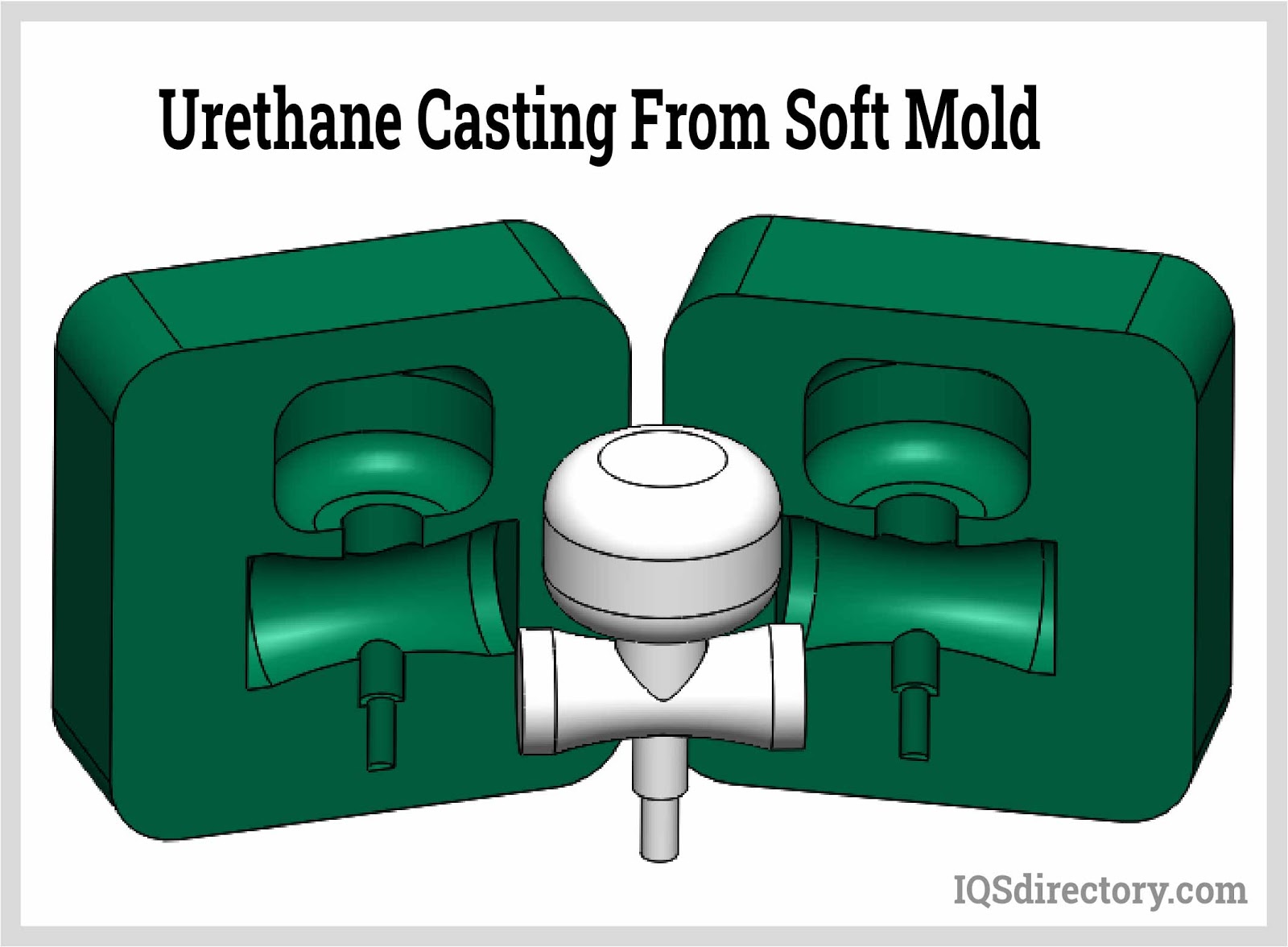
Urethane casting is a manufacturing process where polyurethane, along with other castable resins and specialty additives, is poured or injected into pliable silicone elastomer molds to create precise parts and components. Although it bears similarities to injection molding, this prototyping and production method does not require rigid metal tooling, making it a practical solution for rapid prototyping, bridge production, and low-to-medium volume manufacturing. Because silicone molds are softer and eventually wear out, urethane casting is especially well suited for short runs, custom parts, and repeatable small-batch production.
Castable polyurethane, a subtype of polyurethane resin, can be engineered into advanced, engineering-grade products for industrial, commercial, and consumer applications. Its mechanical properties can be tuned to meet specific performance requirements, ranging from soft and flexible elastomers to hard and rigid plastics, depending on the formulation, durometer, and additive package.
Understanding the Differences between Urethane Casting and Injection Molding
Injection molding is predominantly a technique for high-volume, mass production, especially with thermoplastics. Urethane casting is ideal for low-to-medium volume production and is often chosen for rapid prototyping, pilot runs, small batch manufacturing, and custom parts with varied geometries.
How Does Urethane Casting Work?
Urethane casting, also known as polyurethane casting, is a highly versatile rapid prototyping and low-volume manufacturing process widely used for producing high-quality plastic parts and components. The process relies on four essential chemical components: polyol compounds, diisocyanate compounds, chain extenders or curatives, and performance-enhancing additives.
Urethane casting can be performed using several distinct processing methods to suit different user requirements and part geometries: single shot, prepolymer, and quasi-prepolymer techniques. Modern urethane casting is a popular choice for rapid prototyping, low-volume production, and bridge manufacturing applications. The process supports a wide range of industries, including automotive, aerospace, consumer goods, medical devices, electronics, and industrial machinery.
What is the Urethane Casting Process?
Urethane casting involves creating a master pattern, fabricating a silicone mold, and pouring the liquid urethane resin to form durable, precise components. This process is highly valued for applications including rapid prototyping, bridge manufacturing, and low-volume production in automotive, consumer goods, aerospace, and medical device industries.
Developing the Master Pattern. SLA, PolyJet, or FDM 3D printing, or precision CNC machining, from an accurate CAD model.
Choosing and Mixing the Silicone. Two-component RTV silicone formulations, chosen for mold life, tear strength, elongation, and shrinkage.
Condensation Curing vs. Addition Curing. Two distinct cure chemistries with different shrinkage and precision tradeoffs.
Leading Urethane Casting Manufacturers
Compare capability summaries below, then request quotes directly from the shops on this list.
Related Articles
Request a quote
Send one request to the urethane casting manufacturers listed above, or visit a company profile to request a quote from just that shop.